




Littelfuse temperature sensing technologies NTCs vs RTDs Infographic
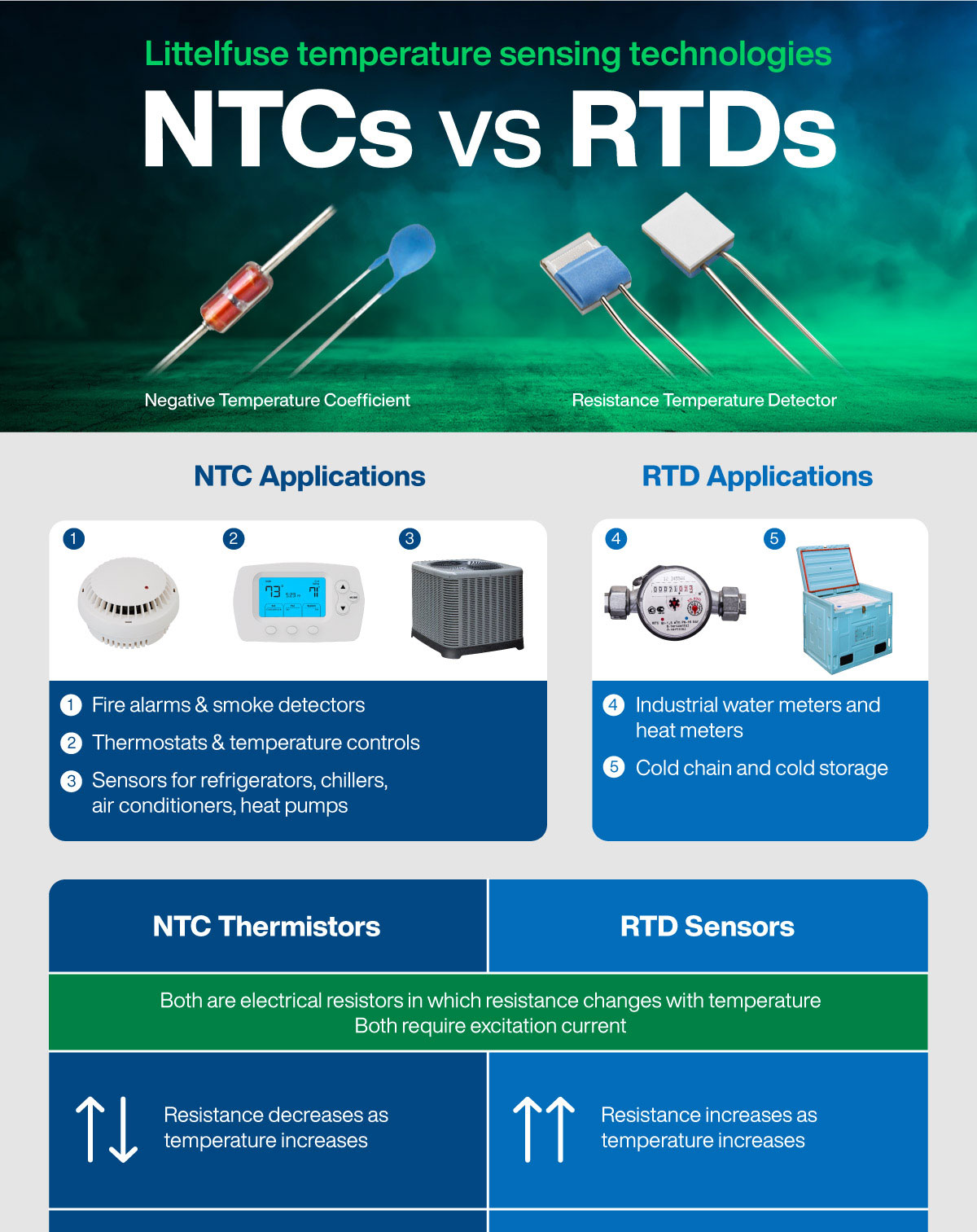


Littelfuse temperature sensing technologies
NTCs vs RTDs
- NTC: Negative temperature coefficient
- RTD: Resistance temperature detector
NTC applications:
- Fire alarms and smoke detectors
- Thermostats and temperature controls
- Sensors for refrigerators, chillers, air conditioners, heat pumps
RTD applications:
- Industrial water meters and heat meters
- Cold chain and cold storage
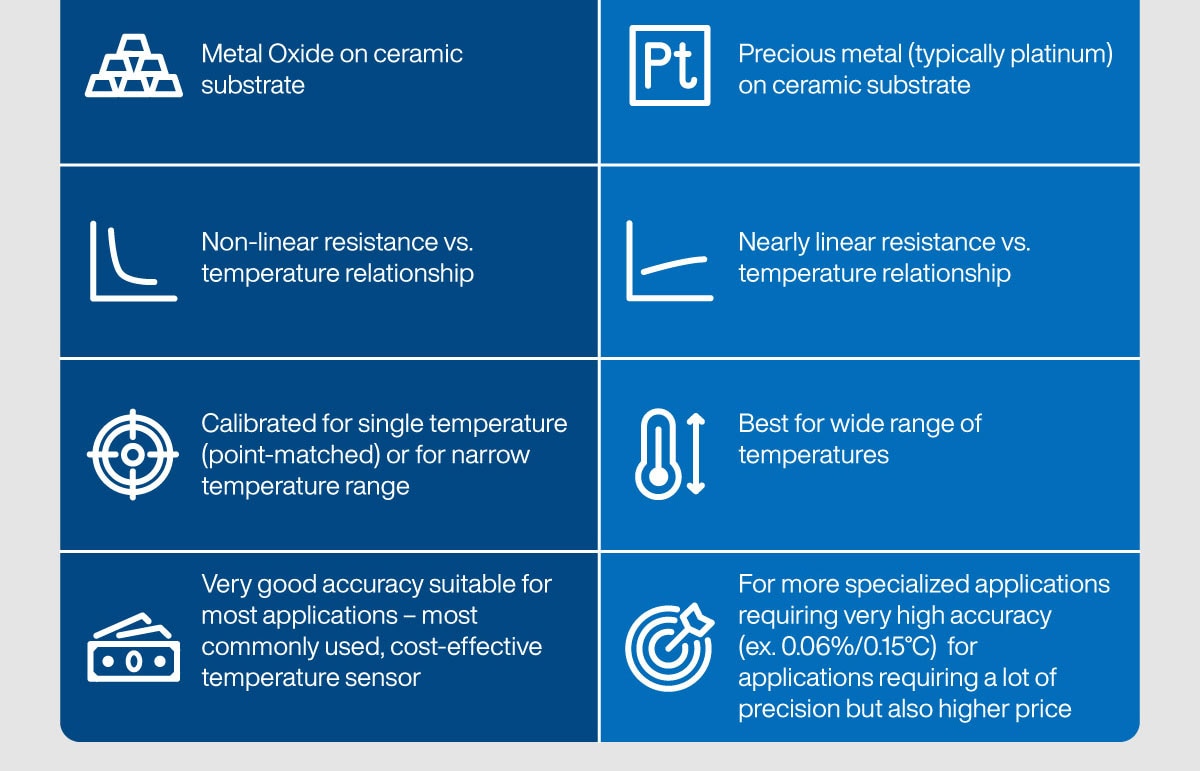
Chart comparing NTCs and RTDs
Both are electrical resistors in which resistance changes with temperature. Both require excitation current.
NTC thermistors:
- Resistance decreases as temperature increases
- Metal Oxide on ceramic substrate
- Non-linear resistance vs. temperature relationship
- Calibrated for single temperature (point-matched) or for narrow temperature range
- Very good accuracy suitable for most applciations—most commonly used, cost-effective temperature sensor
RTD sensors:
- Resistance increases as temperature increases
- Precious metal (typically platinum) on ceramic substrate
- Nearly linear resistance vs. temperature relationship
- Best for wide range of temperatures
- For more specialized applications requiring very high accuracy (ex: 0.06%/0.15℃C) for applications requiring a lot of precision but also higher price
Chart showing an example of typical NTC thermistor vs. RTD sensor curves:
- Temperature (℃C) on the x-axis and resistance (Ω) on the y-axis
- RTD (PT 100 Ω) gradually increases almost lineraly as temperature rises
- Thermistor(2252 Ω at 25℃C) starts with a high resistance at a low temperature and decreases non-linearly as temperature rises