






Sound Solutions for Wireless Audio
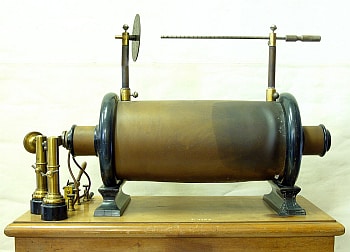
Figure 1 The earliest radios used spark gaps to flood the airwaves with noise in all bands. "Induktionsapparat hg" by Dr. Hannes Grobe - CC BY 2.5
The earliest forms of wireless links used high-voltage spark gaps as a means of communicating. Morse code was used over these primitive radio links as a wireless replacement for the telegraph. For three decades, these were huge boons to ships and aircraft that, for the first time, had a real-time communications link to bases or stations miles away.
When vacuum tubes entered the scene, electronic control allowed the transmission of continuous waves, which permitted modulation to take place. This allowed sound to be transmitted instead of noisy impulse energy that flooded all the bands.
For the first time, the modulation segmented the airwaves into bands so that multiple transmissions could occur simultaneously in the same area. Early signaling links used audio tones for Morse code utilizing audio oscillators.
As the technology was improved by industry and the military, voice-quality systems spawned another growth in use. Bidirectional transceivers allowed real-time voice communications, initially in half-duplex mode. This proved effective for coordinating troops, ships, and aircraft into a more cohesive fighting force.
As new industries embraced wireless technology, improvements such as higher fidelities allowed music-quality mono audio through the use of amplitude-modulated (AM) signaling. The designs and manufacture of inexpensive radio receivers spawned an entire industry providing a low-cost communications network for news and entertainment for the masses (Fig. 2).

Figure 2 Modulation techniques allowed the first wireless audio broadcast systems to create the industries we now take for granted. For the first time, real-time news and audio could be received by the masses. "Radio Transmission Diagram en" By LadyofHats - CC BY 2.5
Transceiver designs also improved as frequency modulation (FM) began to dominate one-way communications like radio stations, as well as two-way communications for military and law enforcement. FM was more noise immune than AM and provided a higher bandwidth, not only providing more fidelity, but also allowing stereo transmission and reception. Relaying radio links kept the world on the edge of their seats as the early astronauts began space exploration, speaking from orbit and eventually the moon.
Many data-gathering instruments also took advantage of primitive AM and FM signaling for scientific research, weather prediction, and global systems like seismograph units. Radio engineers improved and refined radio designs for long-distance transmission of voice, video, data gathering, and control, and we even sent radio signals into space.
Digital Radios Make an Entrance
Digital radio's were initially just digital modulators. AM modulation simply controlled the gating of an oscillator. FM modulation caused digital timing circuits to output one of two frequencies for frequency shift keying (FSK) transmission of digital data. Logic elements soon replaced voltage-to-frequency converters in digital form, and counters, shift registers, logic gates, and flip-flops soon became the common building blocks of radio links. Thanks to precision crystal oscillators, as well as the reliable digital divide and synthesis of clocks and carrier frequencies, digital radios required little tuning and did not suffer frequency drift like their analog counterparts.
Digital also allowed new modulation techniques to emerge, and we saw the use of phase-shift, quadrature-shift, and orthogonal-shift keying techniques, to name a few. Again pioneered by military and security concerns, spread-spectrum and frequency-hopping techniques were released for public use, and the flourishing of modern radio ignited.
Designing Modern Wireless Audio Systems
RF products are highly regulated and controlled by governmental agencies in every country. Therefore, many of the target applications will determine what type of radio, protocol, power level, and frequency band a design can use. Cost is a driving constraint, and in that regard, narrow-band AM/FM are the lowest cost to implement and are still useful for many of today's applications.
For example, a wireless speaker can easily be designed using a tuned or tunable FM stereo transmitter and receiver. Both transmit and receive radios can be implemented with a few transistors and discrete parts, creating a small and low-cost RF link. The same holds true with many toy-like designs such as kids' walkie-talkies. CB radios did a good job of partitioning a frequency band to allow multiple concurrent voice quality links in a given area.
Broadcast AM and FM wireless audio for radio and airwaves television are still viable but for a shrinking market. The widespread use and availability of the World Wide Web, cloud storage, and a frequency-hopping spread spectrum has all but displaced the need for a separate radio. Today, most get their music and audio wirelessly over cellular, Wi-Fi, and Bluetooth links. Other RF standards and protocols can be used, but the majority of the market uses Bluetooth and Wi-Fi technology.
However, AM and FM technology is still a useful low-cost solution for many applications such as radio control links, wireless microphones, baby monitors, nanny cams, and so on. In these cases, when dozens of competing transmitters and receivers are not fighting for bandwidth and air space, the older simpler technologies provide a good solution at lower cost.
Take for example the Silicon Labs Si4689-A10-GM single-chip RF radio receiver. It houses a voltage-controlled oscillator (VCO), PLL, synthesizer, RF tuner, baseband audio processor, AGC, and fairly good 97-dB audio DACs using simple I2C and SPI serial protocols for control and access. With a DSP-based digital radio inside, the AM and FM single chip wireless radio receiver supports standard AM (520-1719 kHz), and FM (76-108 MHz) audio radio decoding, but also can provide concurrent I2S digital audio outputs for integrating the wireless audio with other digital audio components and devices (Fig. 3).

Figure 3 The Silicon Labs Si4689. Even modern AM/FM style radio systems are all internally constructed using digital building blocks. Silicon has replaced copper as bulky and expensive coils are no longer needed.
(Source: Mouser Electronics)
Advantages of digital foundation allow native support of digital services like the radio data services (RDS) for real-time traffic and alerts and also implements the European-sourced Digital Audio Broadcast (DAB and DAB+) VHF (168-240 MHz) band lower fidelity (~ 15 kHz) audio links. DAB is more robust with multi-path fading and noise, but has not replaced the more widespread FM that still provides better signal fidelity.
Development support is also provided by Silicon Labs with the SI468X-WLCSP-EVB that includes a component suggestion BOM, schematics, and PCB layouts for a rather compact six-layer test design that separates analog and digital layers with a ground plane.
It is interesting to note that the fairly small, 7 x 7-mm, package could be used as a remote control receiver utilizing audio modulation as a low-cost one-way data link. A booster rocket fine tuning control link could, for example, co-exist with other more sophisticated RF links and protocols and serve as a redundant safety backup link or fail-safe.
By the same token, dedicated one-way-only transmitters can very effectively use AM and FM techniques to create small and reliable audio or data sensor transmission links, again, using simple and low-cost audio technology.
A rather interesting part from ams is the new AS2977B-BQFM multichannel FSK transmitter. Operating from 300 to 928 MHz, this narrow band 2 to 3.6-V transmitter-only comes in a small, 4 x4-mm package. The -40º to +85ºC chip features an on-chip LDO, which reduces external parts counts and opens the door for possible energy harvesting. The output power levels are programmable and an on-chip temperature sensor compensates the oscillator for crystal frequency-based temperature related drift.
Inside this low-power transmitter is a sigma-delta-controlled fractional-N synthesizer that takes advantage of a VCO and phase-locked loop (PLL) to be able to operate reliably inside any of the unlicensed ISM 300 to 928-MHz bands. The FSK deviation is programmable up to 64 kHz, allowing digital data rates up to 100 kbits/s. Access, control, and data pass through serial bus interfaces to save I/O.
Digital Audio Takes Over
Even modern AM/FM audio transceivers are now using digital technology inside, and almost all wireless audio is in digital forms using digital radios. While technically, 3G/4G and 5G services as well as Wi-Fi access points are a part of the wireless audio technology for the most part, these are just transport services of the digital data used to route the audio information to the desired endpoint.
While the flexible nature of modern digital radio transceiver chips does certainly allow for the design and creation of a proprietary protocol that can be freely used in the ISM bands, unless the requirements exceed the capabilities of a standard, a standard is always the best path to follow. If a proprietary scheme is desired, several good general-purpose parts can be used to forge wireless links for audio intent.
One example of a good streaming audio transceiver to consider is the Nordic nRF24Z1. This is a 4-Mbit/s single-chip RF transceiver that can be used to implement a raw streaming interface for CD-quality 16-bit 48 Ksample/s stereo audio. I2S audio ports are used for digital audio interfaces, and serial SPI is used as a control interface.
Raw interfaces are simpler and do not require a lot of overhead. If multiple users are in proximity, designers need to develop their own arbitration systems and interoperability techniques. Other protocols can be designed and implemented over any raw data stream. This allows designers to forge custom and proprietary audio RF links to provide distinct competitive advantages.
However, most designs need to operate with other equipment. For example, media centers can aggregate services and use Wi-Fi as a point-to-point delivery system for wireless audio. Most handheld devices support Wi-natively, so a well-established compatible link can be quickly brought to a large potential market with lower risk.
Wi-Fi is actually desirable for higher fidelity and more simultaneous channels, since these may require higher-bandwidth sampling and transport. With Wi-Fi, a design engineer can set up payloads and packet sizes that can better deliver the higher band data points. With standard AM/FM, and Bluetooth, the channels and bandwidths are more limited. This means that consumer devices and CD-quality applications in stereo will most certainly use Bluetooth, but, professional and broadcast quality equipment will want to use Wi-Fi.
Wi-Fi or Not?
Many well-engineered Wi-Fi transceiver chips and Wi-Fi modules are well supported and stocked items. In addition, numerous RF development kits and accessories supporting standard as well as proprietary radio designs are on the shelf.
It is interesting to note that the audio portion of the link is no longer analog, so the only audio is on the front-end A/D and back-end D/A stages. This means that external audio input and output stages will be needed when using generic Wi-Fi link devices if it doesn't have on-chip mixed signal functionality. The same holds true for data rates. Low-data-rate parts like the STMicroelectronics' SPIRIT1QTR can be used for some Wi-Fi applications, especially sensors and the Internet of Things, but are not suitable for quality audio, especially with the limited 500-kbit/s throughput.
The Texas Instruments CC3200R1M2RGC may be more suitable with its four-channel 12-bit A/D converters, I2S digital audio ports, embedded 80-MHz ARM Cortex M4 CPU, power management, and more (Fig. 4). A nice feature is the SD/MMC flash interfaces, which are great for adding smart-card connectivity for stored audio files.

Figure 4 The Texas Instruments' CC3200. Modern digital links for audio are embedded processors surrounded by the peripherals needed to capture, filter, and modulate the signals in purely digital form. Either high-end on-chip A/D converters can be used with software based filtering, or, external subsystem blocks can easily be bolted on using serial audio links. (Source: Mouser Electronics)
The maximum attainable fidelity for audio is directly related to data rates, and the 16-Mbit/s data rate has enough room to provide higher fidelity than humans can hear. Even with the higher associated overhead of a digital transport link, this provides enough room for multi-speaker, surround-sound, lossless professional and broadcast-quality audio. Even interoperability with multiple units can be accomplished with channel and bandwidth control and tethering.
The Bluetooth in the Room
Bluetooth has clearly become the de facto standard for low-cost wireless headsets, speakers, and shared audio. The inclusion of Bluetooth on computers, laptops, tablets, and phones has thrust this standard onto everyone's equipment, and it offers some great benefits for designers and users alike.
The CD-quality audio is good enough for most. Only professionals or the "gotta haves" will need more. The tethering is also useful and has proven to be rather effective, even in crowded settings. The range is more than sufficient for personal audio devices that are on-person or part of a Personal Area Network. The power management of transmit power also maximizes battery life and exposes less RF.
Like Wi-Fi, many Bluetooth chips and modules are ready to use with a lot of reference materials, designs, and even software stacks for the IP protocols.
Reliable suppliers like Toshiba provide up-to-date, compliant Bluetooth 4.0 single-chip transceivers like the TC35661SBG-007(EL), which includes support for the legacy streaming audio Bluetooth as well as the Low Energy modes.
Several good Bluetooth chips and modules, such as the Microchip RN52-I/RM Bluetooth Audio Module, can help make this design easier to implement. This audio module is fully compatible with the streaming part of the Bluetooth 3.0 version spec (Fig. 5), meaning it will operate in the 4.x environment that fully supports the legacy streaming audio mode.

Figure 5 The Microchip RN52-I/RM Bluetooth® Audio Module. Wireless audio is made as simple as possible thanks to modular solutions like this, which include stereo audio codecs, speaker/headphone outputs, digital and analog I/O, and serial communications for host control in a certified ready to use form. Even the antenna is on board.
(Source: Mouser Electronics)
The Microchip module is a postage-stamp-sized, fully compliant and certified, two-channel wireless audio-streaming device using S/PDIF and I2S digital interfaces for audio. A UART command interface allows easy setup and control. There is even an integrated amplifier for 16-Ώ speakers.
A Jumping-off Point
In the form of data, wireless audio information is routed and directed through a network of switches, routers, and protocol converters. Often, one wired or wireless standard must extract data for retransmission through another wired or wireless standard. As mentioned earlier, Wi-Fi can be the jumping-off point to Bluetooth, so a device that combines both protocols and standards on a single module or chip makes a lot of sense here.
For instance, consider the Silex Technology SX-SDPAN-2830BT-SP Wi-Fi and Bluetooth transceiver-in-one. With data rates up to 150 Mbits/s, the 3.3-V dual transceiver operates in the 2.4-GHz Wi-Fi B/G and Bluetooth bands, as well as the 5-GHz Wi-Fi /N bands to create an all-in-one dual-band solution.
This transceiver features adaptive radio biasing for better low-power modes as well as hardware-accelerated security. In addition, quality of service standards and schemes are built in to help ensure reliable delivery of data in time.
Note that in actuality, parts such as the Silex Technology SX-SDPAN-2830BT-SP transceiver are actually modules in chip form factors. This can be very desirable in many aspects, not the least of which is the agency certifications and compliances that come along with a manufactured pre-certified solution. The freedom to not have to be intricately involved in the latest and greatest specifications subtleties is also a big bonus, as the module manufacturers are responsible for that. And finally, design and application support practically make designing with wireless a cut-and-paste operation.
Two Designs in One
With time-to-market pressures constantly facing design engineers, modular solutions are often the way to go. They not only allow rapid prototyping and testing, but they also bring with them the encapsulated expertise of rather complex standards in a manufactured form.
Note that costs may be higher with modules since they are finished products in their own right. But, there is no reason that pilot runs and even production runs of a product using modules can't take place while the engineering team is quietly working in the background on their own RF link.
If volumes are high enough, the possible cost savings of creating your own designs can eventually add to the bottom line. But time will still be needed for international certifications once a design is ready for inclusion on the finished products. Also, re-certification may need to take place if components change, become obsolete, or otherwise unavailable. In any case, development support is available as are reference designs, sample code, and even PCB layouts.
Kevin Hess, Mouser Electronics
Vice President Technical Marketing
(817) 804-3833
Kevin.Hess@mouser.com
Kelly DeGarmo, Mouser Electronics
Corporate Communications Manager
(817) 804-7764
Kelly.DeGarmo@mouser.com